What Is a Continuous Flight Auger? A Complete Guide to CFA Piles
9.8.26
If you’re in the business of drilling, you know what a continuous flight auger is, but the name might be a little confusing to the layman. We’ll start with potentially disappointing news to some: It has nothing to do with flying. The good news is, it’s still pretty darn cool.
A continuous flight auger (CFA) is a hollow-stem drilling tool used to install auger cast piles (also known as augercast piles or continuous flight auger piles) without pulling the tool clear of the hole. Let’s dig in (hah).
What Does a Continuous Flight Auger Do?
As the continuous flight auger bores to depth, grout pumps through the stem while the auger stays in the hole, building auger cast piles without a temporary casing.
It helps to separate the tool from the method. The auger itself is the drilling tool. Auger cast piling is the construction method that uses it to place auger cast piles, sometimes called augercast piles, in a single continuous pass.
CFA, Augercast, ACIP: Why One Method Has So Many Names
Every area of the construction industry has settled on at least four names for the same basic process: CFA, auger cast piles, augercast piles, and augered cast-in-place (ACIP) piles. That’s what happens when everyone in the industry is as stubborn as we are.
In U.S. project specifications, augered cast-in-place is the dominant term. CFA shows up more often in international specs and on larger-diameter work, where the tool itself is the point of reference.
Some structural engineers argue that continuous flight augers behave more like drilled shafts than driven piles, since the grout column is placed rather than hammered into position. For a general contractor reading a spec sheet, the practical takeaway is simple: If you see CFA, auger cast, augercast, or ACIP, you’re almost certainly looking at the same drilling method. Just think of them as aliases for the same thing.
How CFA Piles Are Installed
Auger cast pile installation follows four steps on nearly every job:
- The auger rotates into the ground to depth in a single continuous pass.
- Grout pumps through the hollow stem under static head pressure as the auger withdraws.
- A rebar cage is set into the fluid grout while it’s still workable.
- The pile cures in place, with no casing left behind.
“One continuous pass, no temporary casing, and no separate pour crew standing by. That combination makes auger cast pile installation faster than most alternatives.”
Grout volume and pressure monitoring are the quality control points on any auger cast piles job. Crews should watch for under-volume conditions rather than over-volume, since a starved column is the failure mode that threatens pile capacity.
Typical CFA Pile Specs
Specs vary depending on whether the work runs on a dedicated rig or an excavator-mounted attachment, but typical ranges for CFA piles include:
- Diameter: roughly 12 to 30 inches, depending on the rig or attachment in use
- Depth: commonly 40 to 80 feet, with some dedicated rigs reaching further
- Reinforcement cage length: full-length or partial, set according to structural load and uplift requirements
CFA equipment handles a wide range of soil conditions, including sands, clays, silts, gravels, and soft rock.
Where CFA Piles Are Used
Auger cast piles show up across a wide range of commercial applications, including:
Structural support for buildings and parking structures
Earth retention and soil nail walls
Predrilling ahead of piles and wick drains
Tunneling, road work, and bridge work
Flood protection infrastructure
Site conditions tend to favor continuous flight auger piles when a job sits close to existing structures, when groundwater is high, or when neighbors and inspectors are watching vibration and noise closely.
Advantages and Limitations
Advantages:
- No impact noise
- Effectively zero vibration
- No dewatering on most sites
- Minimal spoil and disposal
- Single-pass speed
- No casing removal to schedule around
Limitations:
- Shallower depth and smaller diameter ceilings compared to drilled shafts
- No visual verification of the bearing stratum once the auger is below grade
- Dependence on grout monitoring to catch necking before it becomes a structural problem
- Poor fit for hard rock or obstruction-heavy ground
Auger cast pile installation isn’t the right call on every site, and a general contractor who understands where CFA piles fall short will make better bidding decisions than one who only hears about the upside. Essentially, no one tool is perfect for every application. Don’t let the positives blind you to the negatives, but if you weigh the factors and still favor the CFA, it’ll blow your mind (but not your budget).
How CFA Compares to Other Deep Foundations
| Method | Noise | Vibration | Spoil | Typical Depth Range | Best Use Case |
|---|---|---|---|---|---|
| CFA | Low | Minimal | Low | 40-80 ft | Urban, vibration-sensitive sites |
| Driven piles | High | High | None | 40-100+ ft | Open sites, high capacity |
| Drilled shafts | Moderate | Low | High | 50-150+ ft | Large diameter, deep bearing |
| Helical piles | Low | Minimal | None | 10-60 ft | Light to moderate loads |
| Micropiles | Low | Low | Moderate | 30-100 ft | Restricted access, retrofit |
Want to make sure the neighbors don’t think they’re in the middle of an earthquake? Driven piles may move faster on open sites but bring noise and vibration that CFA equipment doesn’t generate. Drilled shafts reach greater depth and diameter, at the cost of more spoil and a slower single-pile cycle. For a closer look at how these methods stack up on cost and schedule, reach out today.
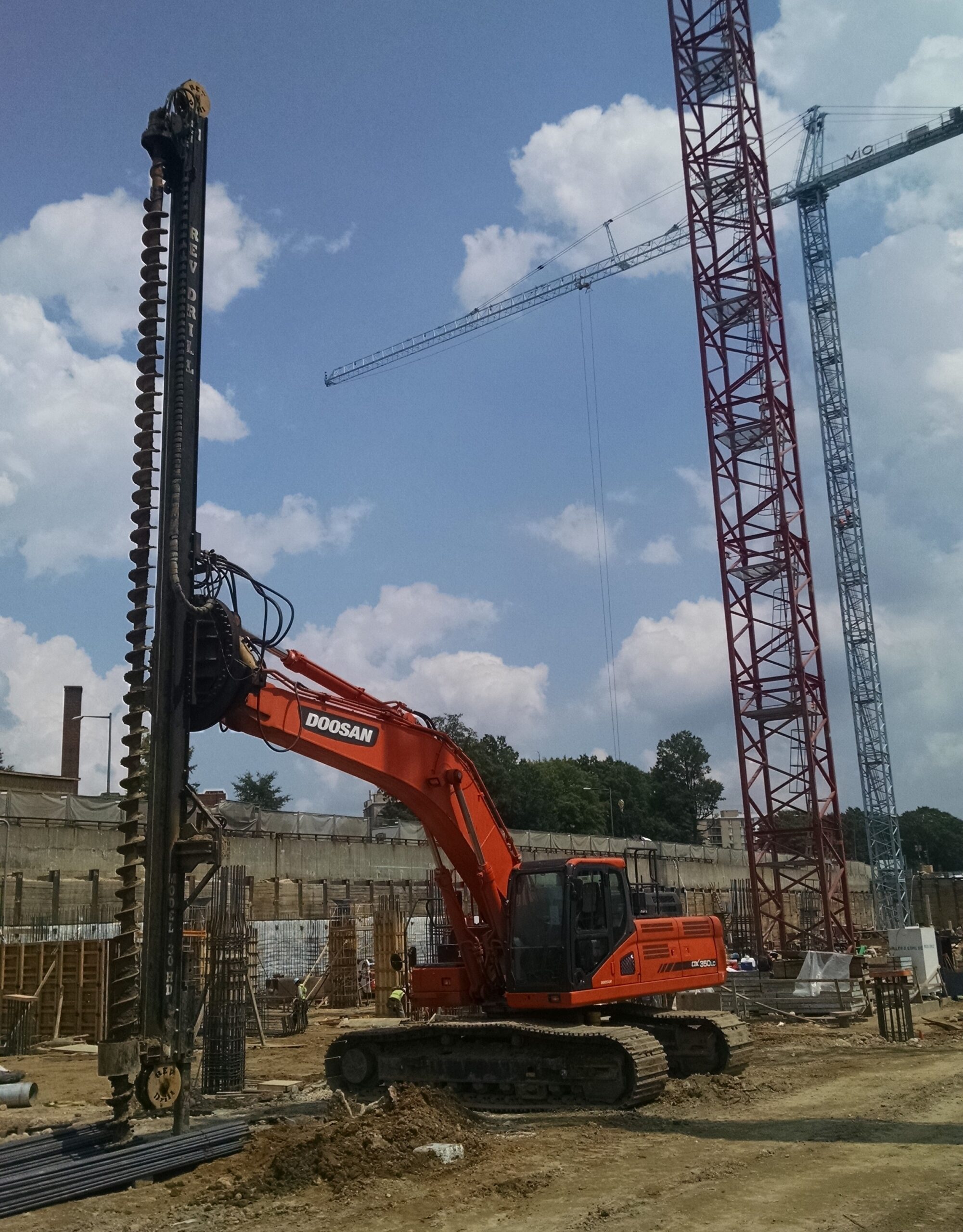
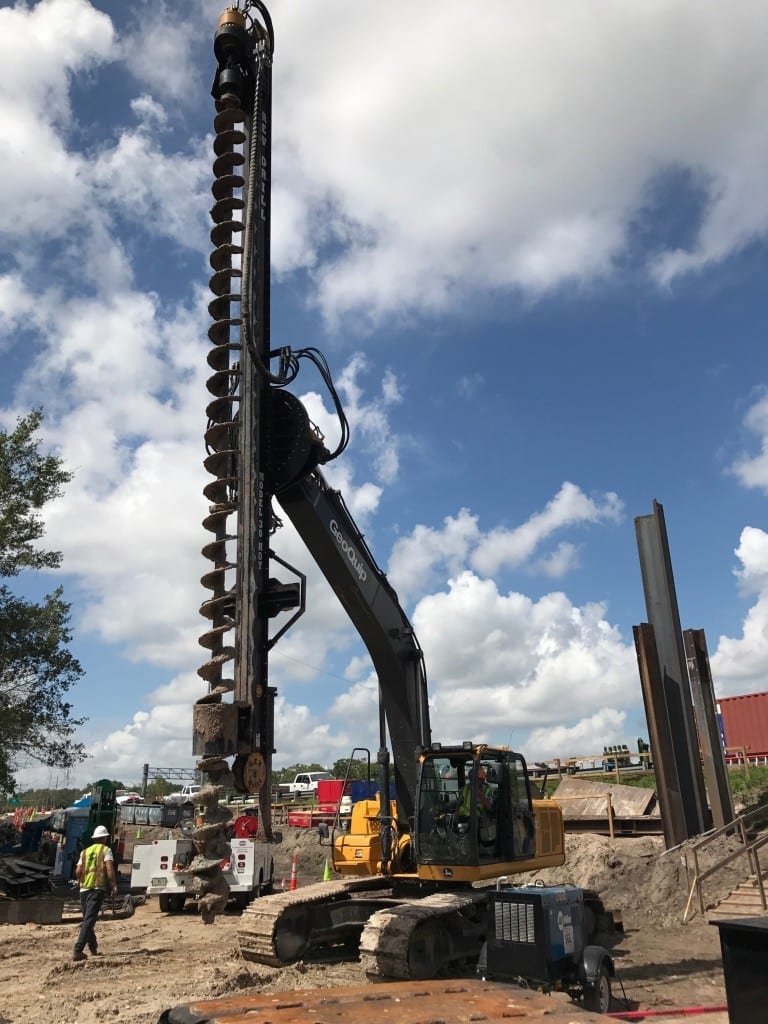
Equipment: Dedicated Rigs vs. Excavator Attachments
General contractors have two paths into CFA work. A dedicated rig delivers purpose-built power and depth capacity, but it comes with a higher capital cost, a specialized crew, and its own mobilization line item.
An excavator-mounted CFA attachment runs off equipment you probably already own. It mounts and dismounts in minutes, uses your excavator’s existing hydraulics, and returns to normal excavation work the moment the piling scope wraps. It’s an embodiment of the simplicity we offer. No ranking competitor covers this option in any depth, largely because most of them sell dedicated rigs and the install service that goes with them.
CFAs for the Win
CFA is a single-pass, low-noise, low-vibration deep foundation method that fits a wide range of soil conditions. It’s a strong option when a site is tight, vibration-sensitive, or sitting on high groundwater.
If your next job checks those boxes, auger cast piles are worth pricing out before you commit to a different deep foundation method. Whether you need to utilize one of these beauties or you’re looking for a different solution, get in touch. Our team knows the drill, and can help you find the right attachment for the job.
Let’s get diggin’!


